When wood is burning, your pellet boiler takes a break.
You heat with wood when you want to, not because you have to: otherwise your pellet boiler switches on automatically.
Keeping supplies in your own cellar has a long tradition in heating – first coal and wood, later heating oil or liquefied petroleum gas. Today, many houses store wood pellets there. The Verbraucherzentrale (consumer advice centre) puts it plainly: “A dry storage room is needed for the pellets. If you previously had oil heating with an oil store, there is enough space here.” This already names one of the most important reasons for a pellet boiler: the fuel is in your own house. You do not depend on a gas pipeline, and you decide for yourself when to top up your supply.
Two further reasons are often decisive when replacing a heating system. An efficient pellet boiler is funded through the heating subsidy of the KfW (German state development bank), and because it heats with biomass, it meets the requirements of the Gebäudemodernisierungsgesetz (GModG, German Building Modernisation Act).
The third reason is technical and often underestimated: temperature. For the heat pump, the Verbraucherzentrale gives a rule of thumb: “a building is suitable if the flow temperature of the heating is below 55 degrees Celsius all year round.”
What this actually says: there are houses that cannot keep to this limit on cold days: either because the radiators are too small and, because of the pipe network, cannot be enlarged to the necessary extent, or because the heating load cannot be reduced far enough to match the installed or installable radiators – for example because insulating the façade is not possible for technical or economic reasons.
For precisely these houses, the state programme Zukunft Altbau in Baden-Württemberg names pellet heating: it “delivers the same high temperatures as gas heating”. Where temperatures cannot be lowered, the pellet boiler plays to its strength. Why the flow temperature is so decisive for the heat pump is explained in the section “The cold day: when a stove relieves the heat pump” on our heat pump page. → With a heat pump
The pellet boiler is funded through the KfW heating subsidy (programme 458) with basic funding and bonuses; what counts is the status at the time you apply. The minimum technical requirements are precise: funding is given to pellet boilers that “integrate a buffer tank volume of at least 30 litres per kW of nominal heat output”. And: “From 1 October 2027, a dust emission limit of ≤ 2.5mg/m³ applies to all biomass systems.”
The LUVANO® itself is not eligible for funding – the guideline expressly excludes hand-fed individual stoves. However, the shared buffer tank is part of the new heating system and can be co-funded as an associated measure through the KfW heating subsidy.
→ Funding
The 30 litres per kilowatt are not red tape. The Technologie- und Förderzentrum (TFZ, Technology and Support Centre) in Straubing ran eight pellet boilers on the test bench at varying loads, just as in the everyday life of a house. Without a buffer tank, the boilers restarted up to six times in the test cycle; with a tank, at most once. And carbon monoxide emissions fell “by up to 80%” with a tank of around 30 litres per kilowatt.
What this actually says: a pellet boiler burns most cleanly when it burns for a long time and evenly. Otherwise, at low load it keeps switching on and off, and every start costs emissions. The tank takes the small loads off it: the boiler charges it in one go, and the house draws the heat gradually. This does not come entirely free – with condensing boilers, the tank reduced efficiency in the test cycle by 5 to 9 per cent. Funding requires it nonetheless, and for the LUVANO® it is a prerequisite anyway.
So anyone who installs a funded pellet boiler already has the tank in the cellar – at least 450 litres for a boiler with 15 kilowatts. For the LUVANO® we recommend at least 500 litres, ideally 800 to 1,000 litres. If the tank is planned at this size from the start, both use it.
Let us imagine a house from the 1970s with radiators that need 65 degrees on cold days. The pellets are stored in the former oil tank room, and next to them is a 15-kilowatt pellet boiler connected to a 900-litre tank. It is a Saturday in November.
In the afternoon, the residents put wood into the LUVANO® in the living room. It transfers up to 85 per cent of its output to the heating water and charges the tank. As long as it is burning or the tank is charged, the TOUCH control holds back the pellet boiler. In the evening the fire is out, and the tank continues to supply the radiators and hot water. Only when heat is lacking does the pellet boiler switch on and recharge the tank as needed.
How much heat the LUVANO® takes on depends on the ratio between the heat demand of the house and the water-side output of the stove; depending on the building, it can be a large share. What the LUVANO® makes possible is shown by feedback from our customers: some use 5 stacked cubic metres of wood a year for supplementary heating, others 15 and more. How much heat you get from wood is up to you. → Can a stove replace the heating?
This is how much energy is in wood
Almost as much as a newly built house with 150m² of living space needs in heating energy for the whole year (around 9,000kWh).
More than an older single-family house uses in heating energy per year (around 20,000kWh).
1 stacked cubic metre of mixed wood, half beech and half spruce, air-dried: around 1,600kWh. Sources: Bayerische Landesanstalt für Wald und Forstwirtschaft (Bavarian State Institute of Forestry), Merkblatt 12 (information sheet 12) (2024); Verbraucherzentrale (2026).
The fact that it is not only used on cold evenings is due to the ratio of room output to total output: because the LUVANO® boiler stove is built like a cellar boiler with viewing windows, it transfers just under 15 per cent of its output to the room. This is why you can run it throughout the heating season – on each of the roughly 220 heating days from September to May and at any time of day.
We hear this question often too. The answer is usually no. On days when nobody puts on more wood – on holiday, for example – the pellet boiler carries the entire heating load. The heating installer therefore sizes its output according to the heat demand of the house, as before.
It can, however, be simpler. The large tank ensures long, even running times, and the more heat the LUVANO® supplies, the less often the pellet boiler has to start at all. (The pellet boiler must be eligible for funding – but alongside a LUVANO® it does not necessarily need the most elaborate version.)
Another aspect is the investment itself. With your heating you create a concept for many years and decades. During this time, circumstances and needs can change. That is why you should not make yourself dependent on your heating system through a special design – after all, this also benefits the value of your property.
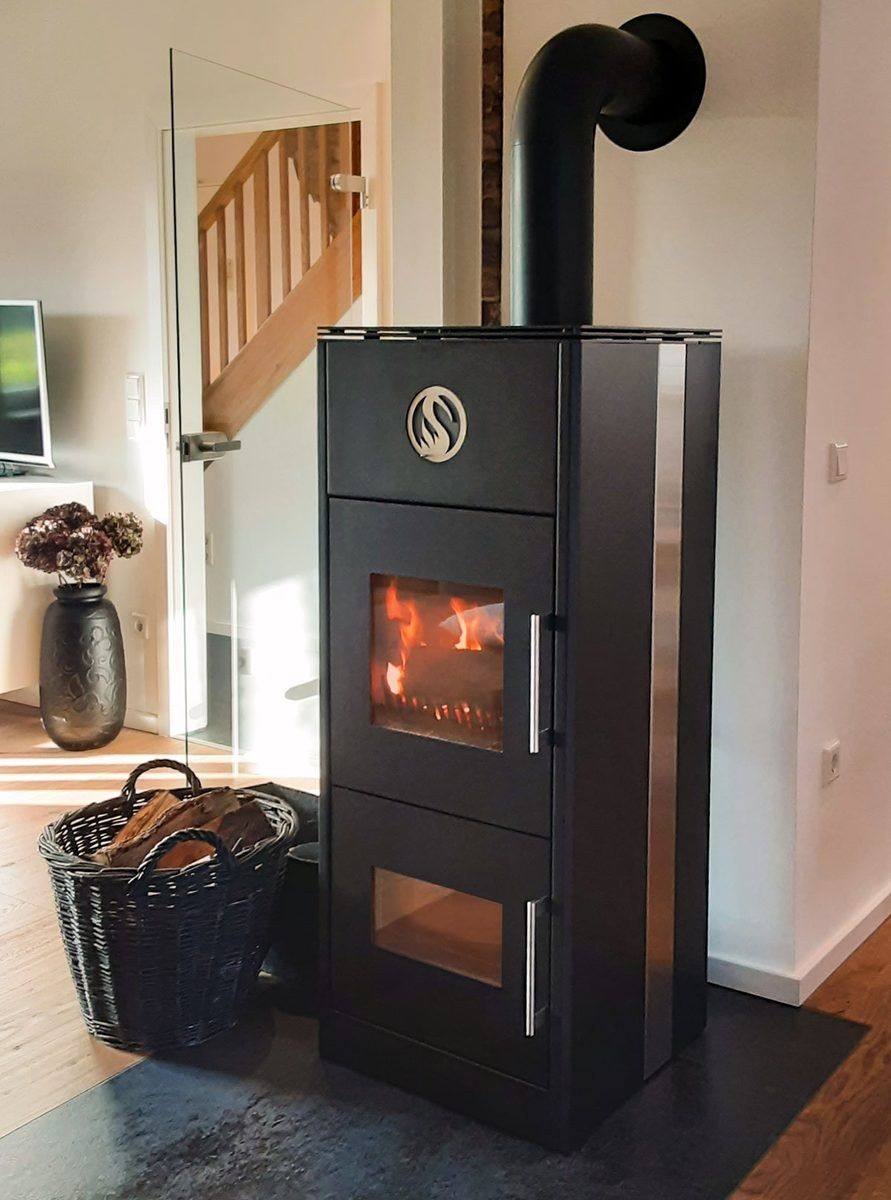
The LUVANO® boiler stove and your pellet boiler share a buffer tank. The LUVANO® charges it with heat from logs, the pellet boiler with heat from pellets, and radiators, underfloor heating and hot water draw on it, regardless of where it comes from. As long as your LUVANO® is burning or the buffer tank is charged, the TOUCH control holds back the pellet boiler when it is not needed. And if you deliberately want to heat with wood only, you lock it out at the touch of a button.
Both heat with wood, but they work differently. The pellet boiler fetches its fuel from the store itself and heats without anyone adding fuel. You operate the LUVANO® deliberately: you add logs when you want and have the fire in front of you.
The concept does not depend on a particular make. A pellet boiler from another manufacturer can, as a rule, also be integrated via the shared buffer tank. We are happy to provide you and your heating engineer with suitable hydraulic diagrams and proposals for integration. You will find more precise details in the planning documents. → Request planning documents If the pellet boiler is still being planned, we can supply everything from a single source on request: pellet boiler, buffer tank, hydraulics and control technology.
In an unrenovated older building, the pellet boiler is at home. Here the LUVANO® takes on part of the heating work, depending on the ratio between heat demand and water-side output.
In renovated existing buildings, the heat demand falls. This allows the LUVANO® to take on a larger share and possibly do all of the heating work, not just in a short transitional period.
In a new build the heating load is small. What matters then is how much heat a stove releases into the room. At just under 15 per cent, overheating of the room where the stove is installed is significantly reduced. → The LUVANO® in a new build
→ Do you still heat with oil or gas today? Supplementing oil or gas heating with a boiler stove
The LUVANO® boiler stove also uses the buffer tank that a funded pellet boiler needs anyway. A pellet boiler is eligible for funding and heats with biomass. Its strengths: it keeps its fuel in stock in your own house, and it also works where flow temperatures cannot be lowered. Depending on the building, the LUVANO® takes on a large share of the heat. This does not usually make the pellet boiler smaller, but it does not need to have the most elaborate technology.
As a rule, yes, even if it comes from another manufacturer. We are happy to provide your heating engineer with suitable hydraulic diagrams. → Integration
For funding of the pellet boiler, at least 30 litres per kilowatt of nominal heat output; for the LUVANO®, at least 500 litres, ideally 800 to 1,000 litres. The larger value is what counts. → Buffer tank
Yes. The stove in principle needs its own chimney; sharing one with the pellet boiler is not permitted. Several stoves, on the other hand, can be connected to the same chimney with the appropriate approval, as long as they operate without a fan. → Which chimney?
Then you stop adding wood. The LUVANO® TOUCH helps here: its display shows how much wood the buffer tank can still take – in kilograms.
That depends on the heat demand of your house, on your pellet boiler and on how often you light the fire. We therefore do not give a blanket figure – we are happy to discuss it with you: +49 9129 90943-0.
The LUVANO® itself is not eligible for funding. If you install a pellet boiler at the same time, the shared buffer tank can be co-funded through the KfW heating subsidy – provided the funding has been applied for before anything is commissioned.
There is a simple solution for a power cut too – talk to us: +49 9129 90943-0.
In principle, the LUVANO® is a boiler stove in accordance with EN 16510 (previously EN 13240). Whether it has to be tested on a recurring basis nevertheless depends on certain circumstances. → Emission testing obligation