First the wood is gasified, then the wood gases burn – spatially separated and with a targeted air supply.
A wood gasifier burns wood in two stages. In the fuel chamber, the wood releases combustible gases under the effect of heat: the wood gases. These burn in a separate combustion chamber with a targeted air supply. With down-draught combustion, the flame is drawn downwards through the ember bed. As only the bottom layer of wood is ever involved in combustion, the burn is even, and you only need to add wood at long intervals.
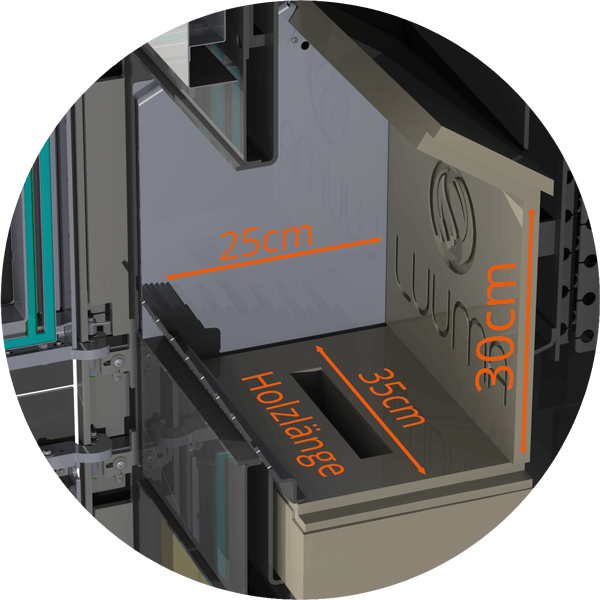
Anyone who heats with wood knows the familiar picture: the flames rise upwards and leap above the logs. With down-draught combustion, the direction is reversed. The flame is drawn downwards, through the ember bed into a combustion chamber below the wood.
Imagine the fuel chamber on an evening, well filled with logs. Right at the bottom lies the ember bed. The primary air, the air for outgassing, flows there: the heat of the ember bed drives combustible gases, the wood gases, out of the bottom layer of wood. They flow downwards through the ember bed into the combustion chamber and burn there with additionally supplied combustion air, the secondary air.
The wood above initially forms a reserve. The Handbuch Bioenergie-Kleinanlagen (handbook on small bioenergy plants) of the Fachagentur Nachwachsende Rohstoffe (German Agency for Renewable Resources) sums up the process in one brief sentence: “As a result, only the lowest layer of the fuel bed takes part in combustion at any one time.” The remaining logs slide down by themselves as soon as space becomes free below. In this way, the wood burns down gradually from below instead of flaring up all at once.
What this actually says: with down-draught combustion, it is not the amount of wood in the fuel chamber that determines the course of combustion, but the bottom layer. The handbook therefore describes the fuel quantity as “largely irrelevant to the combustion process”. The wood gases are produced gradually, and the combustion air can be matched to their quantity – this is not possible in the same way with an upward burn in which all the wood burns at once. According to the handbook, the result is “good burnout and thus high combustion quality”.
In most wood stoves, combustion takes place differently: flames and hot gases rise upwards. With up-draught combustion, the combustion air also flows from below through the entire fuel layer. In the words of the handbook, “all the fuel is heated and reacting at the same time”. With each new load of wood, this process starts all over again.
The Umweltbundesamt (German Environment Agency) describes the consequences for operation. It refers to wood boilers in the boiler room, where this technology has become established: the flame there burns “not upwards through the fuel layer, but sideways or downwards in a separate combustion chamber”. As only the wood above the ember bed is involved, combustion proceeds “virtually continuously and very evenly. You therefore only need to add wood at long intervals.”
With the LUVANO®, you see both areas: the flame in the fuel chamber at the top, the combustion chamber at the bottom. For an experienced wood burner, down-draught combustion is nothing new: in the boiler room, it has been proven technology for around 40 years. With the LUVANO®, wood stove owners have also benefited from it since 2014.
The gasification of wood is not an invention of the wood gasifier. The Umweltbundesamt roughly divides the combustion of solid fuels into four phases. It starts with heating and drying. In the subsequent pyrolysis, the wood decomposes from around 150°C and releases combustible gases. This is followed by gasification and finally the actual combustion, oxidation. For the state after pyrolysis, the Umweltbundesamt notes: “At this stage, only charcoal is left of the original wood.”
This leads to a vivid interpretation. The flames you see behind the glass are burning gases. What remains after the gases have been driven out is familiar from barbecuing: charcoal that glows without forming any significant flames. A wood gasifier therefore does not produce any special gas. It spatially separates processes that otherwise take place “mostly more or less simultaneously” when wood burns: in the fuel chamber the wood is gasified, in the combustion chamber the wood gases burn.
Michael Faraday demonstrated this principle with a candle more than 150 years ago, in his lectures for young audiences at the Royal Institution. He held a small glass tube in the middle of the flame, led the wax vapour through it and lit it at the other end. The candle flame now burned some distance away from the candle. Faraday concluded from this that two different processes take place in the flame: the formation of the vapour and its combustion. A wood gasifier puts this experiment into practice on a large scale.
For the wood gases to burn as completely as possible, according to the Umweltbundesamt, “a sufficient supply of oxygen, good mixing of the combustion gases and sufficiently high reaction temperatures and residence times” are needed. In the combustion chamber, the wood gases meet a targeted supply of combustion air. In the LUVANO®, they are swirled in the patented vortex chamber and burn almost completely – with every type of wood. Overall, more than 90% of the energy contained in the wood arrives as usable heat, over 89% for the 8kW appliance, and little ash is produced.
Wood gasification is best known from boilers in the boiler room. The LUVANO® was developed from such a boiler, the SH series log boiler, and was given glass panels so that you can see the fire. It works with natural draught, i.e. solely with the draught of the chimney and without a fan. In the living room, you therefore only hear the fire. One load burns for over three hours.
Boiler does not mean less of a wood stove. It means a fully fledged boiler stove with a visible fire – plus the advantages of a basement boiler.
Not necessarily. The LUVANO® works with natural draught. A fan kit is only intended for special cases in which the chimney draught is not sufficient. → Which chimney?
Dry, untreated logs. The LUVANO® burns any type of wood; its fuel chamber is designed for log lengths of 25 or 33cm. → Storing and drying firewood
No. Wood gasification describes the combustion principle; a boiler stove is one that transfers heat to the heating water. The LUVANO® is both. → What is a boiler stove?
A stove in which the flame does not rise upwards but is drawn downwards through the ember bed into a combustion chamber below the wood. There, the wood gases burn with additionally supplied combustion air. The LUVANO® is a boiler stove that works on this principle.