When the boiler stove supplies heat, your oil or gas heating takes a break.
With the LUVANO® you heat your house with wood from the living room. If heat is lacking, your boiler steps in automatically.
In Germany almost two thirds of households heat with gas or oil, 48 per cent with gas and 15 per cent with oil. Many of these boilers run reliably, and that is also the most common reason why they stay. In a survey of homeowners who can imagine having a heat pump, a good half named as one of the most important reasons why they have not yet switched: the heating has not yet reached the end of its service life. No reason was named more often. Ripping out a working boiler does not feel right to most people.
Nevertheless, many owners of oil or gas heating are concerned about two things. One is cost: a CO₂ price is added to every kilowatt hour of oil or gas, and nobody knows exactly where it is heading. The other is supply: gas comes from the mains, oil has to be bought in. With a boiler stove you change both without touching your boiler. It stays where it is and only steps in when heat is lacking.
We often hear this question, and the answer has changed this year. Until the summer, a 30-year limit applied to many old oil and gas boilers. With the Gebäudemodernisierungsgesetz (GModG, German Building Modernisation Act), in force since 29 July 2026, it has been abolished. The Federal Law Gazette contains a single sentence on this: “§§ 71 to 73 are deleted.”
What this actually says: there is no longer a general obligation to replace a working oil or gas boiler. The law only sets requirements for the type of heating when a heating system is replaced. Anyone who then installs another oil or gas boiler must, from 2029, produce a growing share of the heat from biomethane, bio-oil or comparable fuels – starting at 10 per cent. So your existing boiler may continue to run. And a boiler stove that supplements it does not change this.
The Verbraucherzentrale (consumer advice centre) calculates it for an older detached house with a consumption of 20,000 kilowatt hours a year. With gas, CO₂ costs in 2026 amount to “between approx. 260 and 310 euros per year”. With oil it is more, because oil emits more CO₂ per kilowatt hour: “between 350 and 410 euros per year”. From 2028 the price in the European emissions trading system is to be determined by supply and demand. The KfW (German state development bank) has calculated what this could mean for 2030: for the same house with gas, “around EUR 300 to over 1,000 in additional heating costs per year” (roughly calculated at 71 to 261 euros per tonne of CO₂).
What this actually says: the CO₂ price is not a fixed amount per house but a surcharge on every kilowatt hour of oil or gas. How high it is for you depends solely on how much oil or gas your boiler burns. Every kilowatt hour of heat that the LUVANO® loads from your wood into the buffer tank is one your boiler does not have to produce. Anyone who heats with wood buys less oil or gas. How much that amounts to over a year depends on what share of the heat the LUVANO® takes on in your house; we therefore do not give a flat figure.
If you heat with gas from the mains, you have no reserve of your own. The Umweltbundesamt (German Environment Agency) puts it soberly: “Russia’s war of aggression against Ukraine since 2022 and the Iran war in 2026 show how vulnerable the gas supply is to international crises.” The same sentence applies to oil, with one word changed.
What this actually says: it is not primarily about price but about time. The moment the gas supplier interrupts delivery, there is no more gas in the house. Wood, on the other hand, lies in the shed or cellar, and it stays there until you put it on the fire. With the LUVANO®, this reserve becomes heat for the whole house – for radiators, underfloor heating and hot water, not just for the living room. With oil heating or an LPG tank there is already a reserve in the house; the wood is then a second one that you top up yourself whenever you want.
There is a simple solution for a power cut too – talk to us.
Prof. Dr.-Ing. Dieter Wolff examined whether a boiler replacement pays off, using measurement data from a condensing boiler project of the Deutsche Bundesstiftung Umwelt (German Federal Environmental Foundation). His result is uncomfortable: “Neither experts nor, even less so, laypeople know in advance whether the planned boiler renewal will be an economic success or a failure.” The calculation behind it is simple. The savings from a new boiler result from the consumption of the old system, multiplied by what the new boiler does better.
What this actually says: what a new boiler saves depends on how much the old one consumes. If consumption is high, the replacement saves a lot. If it is low, there is little left to save – even with the best technology.
This is exactly where the LUVANO® comes in. Let us imagine a detached house from the 1980s with a gas condensing boiler that is twelve years old and runs reliably. The owners are considering whether to replace it with a heat pump. They decide first to put a LUVANO® in the living room, with a buffer tank of, for example, 1,000 litres in the cellar.
In the first winter they light the stove from the first cold autumn day, whenever they like: in the morning or only in the evening after work, at the weekend or during the day. The LUVANO® transfers up to 85 per cent of its output to the heating water and charges the tank. As long as it is burning or the tank is charged, the TOUCH control holds the gas boiler back. Once the fire is out, the radiators and hot water are supplied from the tank. Only when heat is lacking does the gas boiler step in.
At the end of the heating season the gas bill shows what has happened: part of the heat came from wood. With oil heating it is the same – there, the tank level in spring shows it. How large this part is depends on the ratio between the heat demand of the house and the water-side output of the stove, and on how often the occupants light the stove. What the LUVANO® makes possible is shown by feedback from our customers: some heat with 5 stacked cubic metres of wood a year, others with 15 and more. How much heat you obtain from wood is up to you.
This is how much energy is in wood
Almost as much as a newly built house with 150m² of living space needs in heating energy for the whole year (around 9,000kWh).
More than an older single-family house uses in heating energy per year (around 20,000kWh).
1 stacked cubic metre of mixed wood, half beech and half spruce, air-dried: around 1,600kWh. Sources: Bayerische Landesanstalt für Wald und Forstwirtschaft (Bavarian State Institute of Forestry), Merkblatt 12 (information sheet 12) (2024); Verbraucherzentrale (2026).
But with gas consumption, what a new heat source could still save has also fallen. The boiler may therefore keep running until it really reaches the end of its life.
When that day comes, the most important thing is already in the cellar. A new heat pump or pellet boiler connects to the same buffer tank, and the LUVANO® continues to work as before. The Verbraucherzentrale advises: “Plan a heating replacement in good time, before the heating breaks down.” With the tank, you have already completed part of this planning. However, a tank that you install now with the LUVANO® will not be funded later: funding must always be applied for before anything is commissioned. The LUVANO® itself is not eligible for funding.
The full calculation also includes the other side. KfW pays owner-occupiers a bonus when they replace a working oil heating system or a gas heating system that is at least 20 years old. It will be reduced every six months from February 2027 and will no longer apply to applications from August 2028. Whether an early or a later replacement is better for you therefore depends on your consumption. And that also depends on how much heat your wood supplies.
The LUVANO® boiler stove and your oil or gas boiler share one buffer tank. The LUVANO® charges it with heat from logs, the boiler feeds in when needed, and radiators, underfloor heating and hot water draw the heat, regardless of where it comes from. As long as your LUVANO® is burning or the buffer tank is charged, the TOUCH control holds the boiler back – exactly how is up to your settings. And if you deliberately want to heat with wood only, you lock it out at the touch of a button.
The fact that it is used not only on cold evenings is due to the ratio of room output to total output. With many boiler stoves, a considerable part of the heat remains in the room where the stove is installed. Because the LUVANO® boiler stove is built like a cellar boiler with viewing windows, it transfers just under 15 per cent of its output to the room. That is why you can run it throughout the heating season, on every one of the roughly 220 heating days.
Your oil or gas boiler stays as it is, whichever manufacturer made it. The LUVANO® is connected to your existing heating system via the shared buffer tank; the control for the boiler is already built into the LUVANO® TOUCH. We are happy to provide you and your heating engineer with suitable hydraulic diagrams and proposals for integration. You will find more precise details in the planning documents. → Request planning documents
In unrenovated older buildings, oil or gas heating has often been at home for decades. Here the LUVANO® takes on part of the heating work, depending on the ratio between heat demand and water-side output.
In renovated existing buildings, the heat demand falls. This allows the LUVANO® to take on a larger share and possibly do all of the heating work, not just in a short transitional period.
In a new build the heating load is small. What matters then is how much heat a stove releases into the room. At just under 15 per cent, overheating of the room where the stove is installed is significantly reduced. → The LUVANO® in a new build
A working oil or gas heating system may continue to run; since the Gebäudemodernisierungsgesetz there is no longer any obligation to replace it. A boiler stove supplements it via a shared buffer tank: every kilowatt hour from wood is one the boiler does not have to produce, and the wood is stored in your own house. Because the LUVANO® transfers just under 15 per cent of its output to the room, you can run it on every heating day. If the boiler is replaced later, the new heat source connects to the same tank.
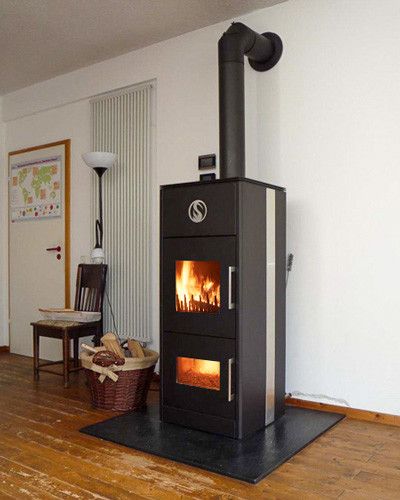
If you light it regularly, it will become your main heat source. For times when no wood is added – on holiday, for example – an automatic heat source makes sense: your oil or gas boiler, or later a heat pump or a pellet boiler. → Can a stove replace the heating system?
Yes. The LUVANO® is integrated via a shared buffer tank; your oil boiler stays and steps in when heat is lacking.
Yes. Whether it is a gas boiler in the cellar or a wall-mounted gas boiler: the LUVANO® is integrated via a shared buffer tank, and your gas boiler steps in when heat is lacking. If your boiler also heats hot water on demand (combi boiler), you decide with your heating engineer: either the hot water preparation stays as it is, or in future the hot water is provided with the help of the buffer tank – for example on the instantaneous principle in the tank or via an external fresh water module.
No, there is no longer a general obligation. A working boiler may continue to run; the Gebäudemodernisierungsgesetz only sets requirements for the type of heating when a heating system is replaced.
Yes: at least 500 litres, ideally 800 to 1,000 litres. The buffer tank connects the LUVANO® hydraulically to your heating system. → Buffer tank
No, that is not permitted. The stove always requires its own chimney. Several stoves, on the other hand, can be connected to the same chimney with the appropriate approval, as long as they work without a fan. → Which chimney?
As a rule your oil or gas boiler, as before. To do so, it charges the buffer tank as necessary.
That depends on the heat demand of your house, on the price of your oil or gas and on how often you light the stove. We therefore do not give a flat figure – we are happy to discuss it with you: +49 9129 90943-0.
The LUVANO® itself is not eligible for funding. A buffer tank can only be co-funded together with a funded heat pump or a funded pellet boiler – and only if the funding has been applied for before anything is commissioned. A tank that was commissioned beforehand will not be funded retrospectively. → Funding
No, provided the integration is right. As long as the buffer tank is hot, your gas heating is idle anyway. When it steps in, it takes its return water from the cool lower part of the tank and therefore often makes better use of the condensing effect than before. Exactly how this is connected is set out in the hydraulic diagram.
Then you stop adding wood. The LUVANO® TOUCH helps here: its display shows how much wood the buffer tank can still take – in kilograms.
In principle, the LUVANO® is a boiler stove in accordance with EN 16510 (previously EN 13240). Whether it has to be tested on a recurring basis nevertheless depends on certain circumstances. → Emission testing obligation