Cosy in the living room, warm throughout the house.
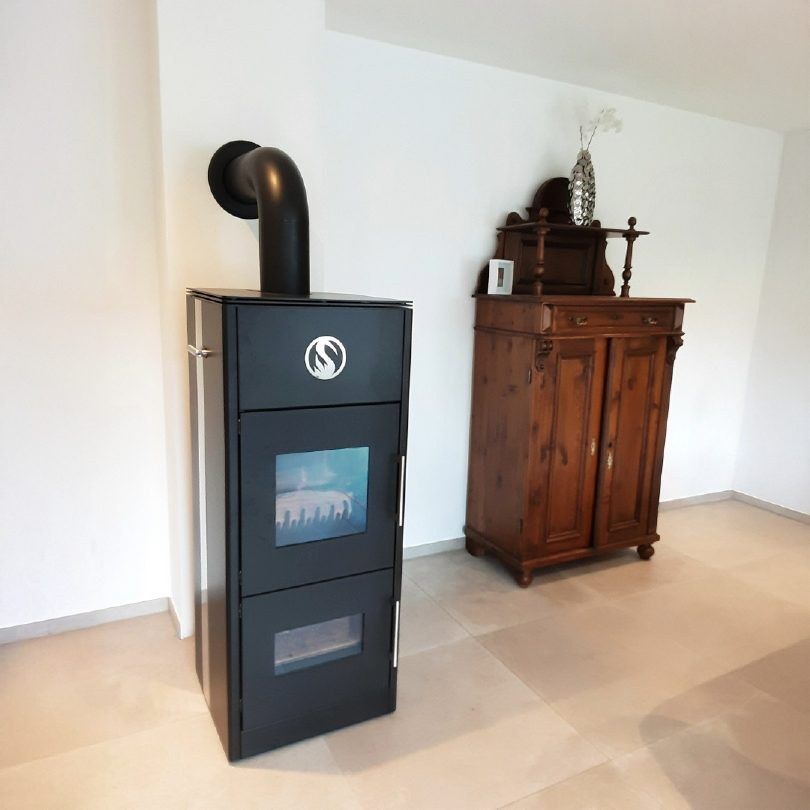
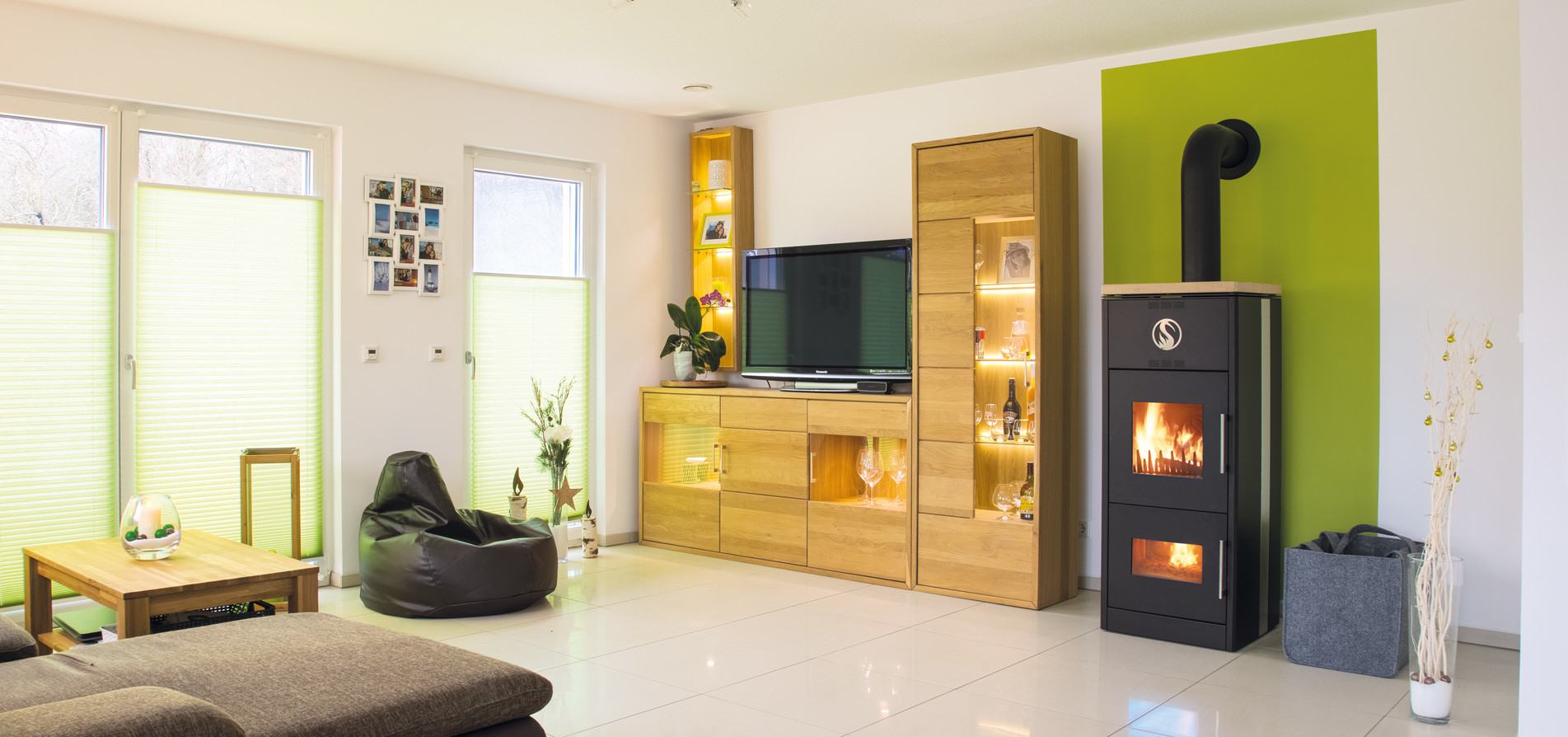
In a special way, the LUVANO® turns your stove fire into heating for the whole house: only just under 15% stays in the living room, the rest also heats the bathroom and bedroom via the heating water.
People who have a wood stove rarely have it just for heating. In a survey by the Umweltbundesamt (German Environment Agency), a large proportion of stove owners cited comfort and cosiness as a reason; only 6 per cent said no. In addition, 62 per cent wanted to reduce the heating costs of their main heating system and 58 per cent wanted to be more independent of oil and gas. The fire is part of the evening, the weekend, the winter.
And yet many owners know the same picture. The living room quickly gets warm, soon too warm, while the bathroom and the rooms upstairs stay cool. Stiftung Warentest (German consumer testing organisation) described it years ago: “Many wood stoves have an output of 6 or 8 kilowatts. That is too much for an average living room – especially in a low-energy house. It is not uncommon for residents to then fling the windows open.”
The Verbraucherzentrale (German consumer advice centre) sums it up in one sentence: “Wood stoves usually only heat one living space, which is why they are also called single-room combustion appliances.” If you want a wood stove anyway, you can get it right straight away when replacing it – and without any notable disadvantages.
The research report “Die Zusatzheizung” (The supplementary heating) by the Bundesinstitut für Bau-, Stadt- und Raumforschung (German Federal Institute for Research on Building, Urban Affairs and Spatial Development) states what explains the problem: “The smallest wood stoves available on the market have an output of 4–5 kilowatts (kW).” In average-sized new single- and two-family houses, the total heating load is 5 to 6kW – there, the output of the wood stove often corresponds to the demand of the entire building.
What this actually says: even the smallest wood stove is as powerful as the heating of an entire new house – on its coldest day. And it releases this output into a single room. But most days of the heating season are not cold days. The Verbraucherzentrale Rheinland-Pfalz writes: “On most days of the year, however, the heating load is considerably lower.”
Let us imagine an evening in October. It is 10 degrees outside, 20 in the living room. To maintain this temperature, the room might need one kilowatt; the transition from summer to winter is gradual. The family lights their wood stove, which heats the room at 6 kilowatts. After an hour, the thermometer shows 25 degrees. Someone opens the window. Upstairs in the bathroom it is cool, because almost none of the stove's heat reaches it.
The stove is not set incorrectly, and the family is not heating incorrectly. A conventional wood stove releases the heat from the wood where it stands. It can neither store it in the long term nor easily send it to other rooms. The research report puts it soberly: “Simple wood stoves often cannot store excess heat and release it at a later time.”
Turning it down is not the solution either. The Verbraucherzentrale writes: “Wood stoves achieve the best combustion at full load.” A stove burning on a low flame burns the wood less well – like an engine that constantly runs at too low revs. At the same time, this can have a negative effect on the chimney. What makes sense, therefore, is a stove that is allowed to burn at full output because most of the heat does not stay in the room.
This is precisely where the difference that matters lies: the ratio of room output to total output. A boiler stove transfers part of its heat to the heating water, but with many appliances still a considerable part to the room. Because the LUVANO® boiler stove is built like a basement boiler with viewing windows, it releases only just under 15 per cent of its output into the room – around 1.2 kilowatts for the 8kW model. That is roughly what the living room needs on that October evening. Up to 85 per cent goes into the buffer tank and from there to the radiators in the bathroom and upstairs.
Many people ask whether they have to replace their wood stove. The Verordnung über kleine und mittlere Feuerungsanlagen (German Ordinance on Small and Medium Combustion Plants) covered older stoves in four stages; the last deadline for stoves with a rating plate dated 1995 to March 2010 expired on 31 December 2024. There is currently no new deadline. A good third of the approximately 11.7 million stoves and cookers for solid fuels in Germany date from these years. Your chimney sweep will clarify whether your stove complies with the limit values.
A boiler stove needs more than a flue pipe. The LUVANO® requires a buffer tank, at least 500 litres, preferably 800 to 1,000 litres, and integration into your heating system. There, the tank absorbs the heat that the living space does not need and passes it on to the building's heating surfaces and the hot water – even after the fire has gone out.
The chimney is also reassessed during replacement. Since 2022, requirements for the height of the chimney outlet have applied when replacing a wood-burning stove. The chimney sweep determines beforehand whether everything is in order. A chimney that was sufficient for the old stove may therefore need adjusting. In future, too, the wood stove cannot share the chimney with other heat sources such as oil, gas or pellet heating: as a rule, it needs its own. Using our accompanying survey form, we assess suitability free of charge. You will find more details in the planning documents. → Request form and planning documents
If your stove already helps heat via the heating water, much of this is already in place. → Replacing a boiler stove
The fire stays as you know it – visible on the LUVANO® thanks to two viewing windows, top and bottom. Added to this is what it has adopted from the basement boiler: wood gasification technology, an efficiency of around 90 per cent and a load that burns for over three hours (depending on the appliance size). Your existing heating stays and steps in automatically when heat is lacking. → Can a wood stove replace your heating? · How does a wood gasification stove work?
The fact that you can light the fire not just on cold evenings but throughout the entire heating season is, again, down to the ratio. With just under 15 per cent room output, you can operate the LUVANO® on any of the around 220 heating days you wish. What the LUVANO® makes possible is shown by our customers' feedback: some supplement their heating with 5 stacked cubic metres of wood a year, others with 15 and more. How much heat you obtain from wood is up to you.
This is how much energy is in wood
Almost as much as a newly built house with 150m² of living space needs in heating energy for the whole year (around 9,000kWh).
More than an older single-family house uses in heating energy per year (around 20,000kWh).
1 stacked cubic metre of mixed wood, half beech and half spruce, air-dried: around 1,600kWh. Sources: Bayerische Landesanstalt für Wald und Forstwirtschaft (Bavarian State Institute of Forestry), Merkblatt 12 (information sheet 12) (2024); Verbraucherzentrale (2026).
In an unrenovated old building, the LUVANO® can take a substantial load off from the first heating day thanks to its high water output.
In renovated existing buildings, the heat demand falls. This allows the LUVANO® to take on a larger share and possibly do all of the heating work, not just in a short transitional period.
In a new build, the heating load is small, and that is precisely where a conventional wood stove overheats the room fastest. With only just under 15 per cent, overheating of the room where the stove is installed is significantly reduced; for a new build, the 8kW version is the obvious choice. → The LUVANO® in a new build
A conventional wood stove naturally releases its heat into the room in which it stands. Even the smallest stoves are as powerful as the heating of an entire new house – which is why the living room gets too warm while the rest stays cool. When replacing it with the LUVANO® boiler stove, only just under 15 per cent stays in the room; up to 85 per cent heats the whole house via the buffer tank. In addition, there is a tank, integration into the heating system and the chimney check.
There is no general obligation. The last transitional deadline for older wood stoves expired at the end of 2024; there is currently no new one. Your chimney sweep will clarify whether your stove complies with the limit values.
Often, yes. When replacing the stove, the chimney sweep also checks the height of the outlet. In the end it is a question of height, effective height, diameter and material. Using our survey form, we assess suitability free of charge. → Request the form · Which chimney?
Yes: at least 500 litres, ideally 800 to 1,000 litres. It takes up the heat the living room does not need. → Buffer tank
The LUVANO® is available with 8, 10 and 15 kilowatts. Which size suits your house depends on the heat demand in combination with the buffer tank and the room where the stove is installed. → Planning
The LUVANO® itself is not eligible for funding. A buffer tank can only be co-funded together with a funded heat pump or a funded pellet boiler – and only if the funding has been applied for before anything is commissioned. → Funding
There is a simple solution for a power cut too – talk to us: +49 9129 90943-0.
In principle, the LUVANO® is a boiler stove in accordance with EN 16510 (previously EN 13240). Whether it has to be tested on a recurring basis nevertheless depends on certain circumstances. → Emission testing obligation