Whether your chimney is suitable can be clarified before you buy.
Like any wood-burning appliance, a boiler stove needs a chimney that is suitable for solid fuels and provides sufficient draught. Whether an existing chimney is suitable depends on its cross-section, height and condition – and on whether other appliances are already connected to it. No estimate is needed for this: suitability can be calculated before you buy a stove.
Imagine a living room in a house from the 1970s. An old wood stove stands there, connected to a brick clinker chimney with a large cross-section. With this stove, the chimney has drawn more or less reliably all these years. Now a boiler stove is to take its place, and the first question is obvious: is the existing chimney suitable for it?
The answer does not lie in the chimney alone. To be able to judge whether it is suitable (without additional measures) for a particular stove, the entire system from the air inlet to the chimney outlet must always be considered. German pollution control law, too, counts as part of the combustion installation not only the stove but also, “where present, equipment for supplying combustion air, the connecting piece and the flue gas system”. The following paragraphs follow this path in the direction in which the air flows.
What sets the air moving along this path is the chimney itself. Roughly speaking in technical terms, different temperatures in it create different air pressures, which in turn cause convection and thus buoyancy inside; this is called the “chimney effect”. The resulting “chimney draught” ensures that the flue gases are carried away. This in turn creates negative pressure in the appliance, which allows the fresh air needed for combustion to flow in. The chimney draught is extremely important and can therefore rightly be described as the “engine” of combustion. If, as described here, this happens entirely without additional fans, it is called the natural draught principle.
For this, however, the flue pipe, chimney and, where applicable, the air supply must suit the stove. In practice, the weather conditions and especially the outside temperature also influence the chimney effect. As a rule, the colder it is outside, the better it works. It is the same buoyancy that makes a hot-air balloon rise: warm air has a lower density than cold air. The colder the outside air, the greater the difference in density compared with the warm flue gas in the chimney.
At the start of the path is the air inlet. Just as important as the question of the chimney is the question of how the stove is supplied with combustion air. As a rule, this comes from the room. In buildings with an airtight envelope, as is the case in new builds, it is advisable to bring the air supply to the stove from outside through an insulated duct. If a so-called air handling system, e.g. a ventilation system, is present, this approach may be mandatory, as may room-sealed operation of the stove, which today is regulated by EN 16510.
Next comes the stove. The more energy the stove gives off to the room air and, as in the case of the LUVANO®, to the water, the less is lost via the chimney. Modern stoves have a very high efficiency, the LUVANO® around 90 per cent. For the chimney, this means: the more heat remains in the building, the lower the flue gas temperature at which the flue gas reaches the chimney. Experience with the old stove therefore says little about the new one. A chimney is not suitable as such, but always for a specific stove.
Between the stove and the chimney is the flue pipe. The most important criterion here is the pressure conditions: the cross-section of each section has an influence, just as every bend does. Every resistance that the air supply or the flue gases have to overcome increases the chimney draught requirement of the system. A rule of thumb thus says that every additional bend in the flue pipe requires one metre more chimney height.
In the chimney itself, it is decided whether the flue gas reaches the outlet at a sufficient temperature. Depending on its construction, the chimney naturally also absorbs more or less heat. As a result, the flue gas temperature can drop so far that condensate (moisture) can form in the chimney. This happens above all when the cross-section is too large or the chimney is poorly insulated, i.e. loses too much heat. This problem occurs particularly frequently in old flues built from clinker bricks or in open-pored ceramic chimneys (e.g. fireclay inner liners) with a large cross-section. A chimney suitable for a modern wood stove should therefore be well insulated and, if necessary, insensitive to moisture.
For solid-fuel appliances, the chimney must also be resistant to soot fires.
For the clinker brick chimney from our example, this is exactly where the decisive question arises. If such a chimney is too large or not insulated, renovation is the best solution – for trouble-free operation and to avoid damage to the chimney.
The path ends at the chimney outlet. The effective height of the chimney helps determine the strength of the chimney draught. Since 2022, the 1. BImSchV (German Ordinance on Small and Medium Combustion Plants) has also set requirements for the outlet; more on this in the section on the outlet height.
At the end of this path, there is one key figure for the stove: its draught requirement. The LUVANO® requires a chimney draught of 12Pa at 8kW and 15Pa at 10 and 15kW. Whether the chimney from the example delivers this draught while operating without condensate forming depends on its cross-section, insulation and height, as well as on the bends in the flue pipe. Only the calculation shows this reliably.
For the cross-section and height of a chimney, the Feuerungsverordnung (firing ordinance of the German federal states) prescribes not a dimension but a result. Flue gas systems must be “dimensioned according to their clear cross-section and height, and where necessary also according to their thermal resistance and the nature of the inner surface, in such a way that the flue gases are discharged into the open air in all intended operating conditions”.
What this actually says: cross-section, height, insulation (which is what “thermal resistance” refers to) and the nature of the inner surface are exactly the stations we have just looked at along the air path. The phrase “in all intended operating conditions” means: not only at full output on a cold evening, but also during the heating-up phase or on a mild autumn day. Whether a chimney meets this requirement therefore cannot be read from any single dimension.
Empirical values for chimneys give a first indication of whether your chimney is well suited to the LUUMA LUVANO®. But from a length of 5m, better 6m, and with a cross-section of no more than 180 and no less than 150mm, the chimney is suitable in many cases. A chimney cross-section calculation provides planning certainty. With it, the data of the chimney (length, construction, cross-section) and the air supply conditions can be used to determine reliably whether your chimney is suitable.
A shared flue is also possible in principle. The prerequisite is that the connected appliances are approved for this and that technical suitability is confirmed by a chimney calculation. This applies to stoves without a fan – i.e. the LUVANO® without a fan kit. Among other things, the Feuerungsverordnung requires that the flue gases are discharged in every operating condition and that no flue gas escapes through an appliance that is not in operation at the time.
Since 1 January 2022, requirements for the height and position of the chimney outlet have applied to solid-fuel appliances (§ 19 of the 1. BImSchV). They apply to newly built and substantially modified installations; replacing an appliance is treated as equivalent to a substantial modification. Whether the requirements are met is determined by the chimney sweep before commissioning.
For the replacement of a stove, paragraph 2 contains a short sentence: “Sentence 1 applies accordingly to the replacement of the appliance.” What this actually says: even if you only replace the appliance and keep the chimney, you are subject to the requirements for the outlet – namely those for modified installations, not those for newly built ones.
In its interpretation questions, the Bund/Länder-Arbeitsgemeinschaft Immissionsschutz (German Federal/State Working Group on Pollution Control) draws the line according to what was previously operated on the chimney. Anyone who replaces a solid-fuel stove installed and operated before 2022 with a new one is subject to the rules for modified installations. Anyone who, on the other hand, connects a stove to a currently unused chimney, or an additional appliance to a chimney already in use, is building a new installation. Maintenance and repair of the chimney do not trigger any new requirements.
What this means for your chimney is something the chimney sweep will clarify with you.
Your responsible chimney sweep inspects and approves the stove before it is first put into operation. Later, during the Feuerstättenschau (periodic inspection of combustion appliances), he checks the operational and fire safety of the installation. You should therefore involve him at the planning stage and obtain his approval. As the owner, you are in any case obliged to notify him of the installation of a new appliance.
If your chimney is not suitable for operating a LUVANO® because of its length, cross-section or construction, there is (almost) always a solution.
A cross-section that is too large and the associated draught and temperature problems, just like an unsuitable construction, can usually be solved by renovating the chimney. This involves installing a stainless steel pipe, which is inherently insensitive to moisture and ideally also insulated, in the existing chimney.
If the draught problem is caused by insufficient effective height of the chimney, a chimney extension can help. With the LUVANO®, there is a further solution: a small fan kit fitted directly in the stove can compensate for missing chimney draught. On the LUVANO® TOUCH it can also be retrofitted, on the LUVANO® TOUCH PLUS it is factory-fitted, and on the LUVANO® BASIC it is not possible.
Whether a chimney is suitable for a boiler stove is determined by the entire system from the air inlet to the outlet – and by the stove that is to be connected. Empirical values give a first indication; only the calculation provides planning certainty. If the draught is insufficient, there is (almost) always a solution.
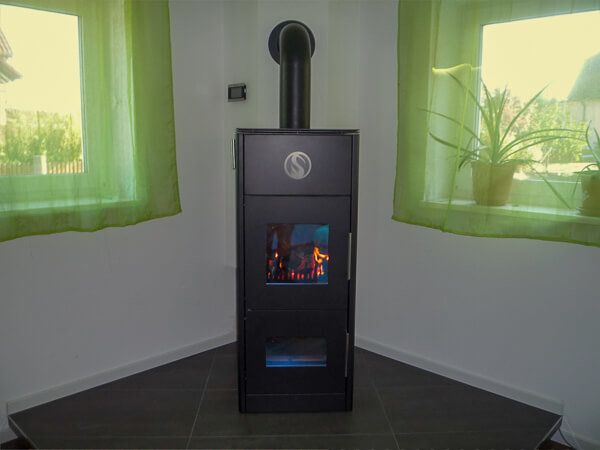
The LUVANO® works on the natural draught principle: without a fan kit, no fan runs during operation; you only hear the fire. It is connected via a flue connection of 150mm. In the room-sealed version in accordance with EN 16510 – previously already approved by the DIBt (German Institute for Building Technology) – it draws its combustion air from outside via its own duct. In a new build, it is best to plan the chimney from the outset; on request, we also supply the chimney system and flue pipes.
We check free of charge before you buy whether your chimney is suitable for the LUVANO®. The form for this comes in two versions: for a chimney with one appliance and for one with a shared flue. You will receive it with the information pack. (Your satisfaction is our top priority – which is why we clarify everything that is important for success before you buy.)