Little heat for the room, a lot of heat for the house – even in an efficiency house.
In a well-insulated house, even the smallest ordinary wood stove is too powerful for the room it stands in. The LUVANO® boiler stove transfers just under 15% of its output to the room where it is installed, and most of it via the buffer tank to the whole house.
Anyone building a detached house today usually plans in a heat pump. According to the Statistisches Bundesamt (Federal Statistical Office), 77.9 per cent of the detached houses completed in 2025 are heated mainly with a heat pump. But the same release also mentions the wood stove: renewable energies are “also used as a supplementary energy source, for example through a wood stove”.
The wish is understandable. For many people, a fire is part of living – of the evening, the weekend, the winter. And yet in a new build it faces a contradiction. The research report “Die Zusatzheizung” (“The supplementary heater”; co2online, funded by the Bundesinstitut für Bau-, Stadt- und Raumforschung, the Federal Institute for Research on Building, Urban Affairs and Spatial Development) names it openly: “The heat output of supplementary heaters is generally significantly higher than required.”
With an ordinary wood stove it therefore often does not work at all in a well-insulated house – not because the fire is a nuisance, but because the room output is far too high.
What the report means by this is stated in the very next sentence: “The smallest wood stoves available on the market have an output of 4–5 kilowatts (kW). Particularly in average-sized new single- and two-family houses, whose total heating load is in the order of 5–6kW, the output of the supplementary heater often corresponds to the demand of the entire building.”
What this actually says: the stove is not too powerful for the house, but for the room. On the coldest days, a new single- or two-family house as a whole needs about as much output as even the smallest wood stove gives off into a single room. For new detached houses the authors therefore consider stoves with 1 to 3kW appropriate, and for a stove that burns only for atmosphere, “up to 3kW”.
What this feels like is shown by a Saturday in November. A family has been living in their new house for a year, with a heat pump and underfloor heating, the living room open to the kitchen. Outside it is 6 degrees; the living room needs perhaps 1kW. In the afternoon they light the wood stove, 5kW nominal output, the smallest available from specialist dealers. After an hour the thermometer reads 25 degrees. The underfloor heating can do nothing about it. So a window is tilted open. The wood burns, and part of its heat goes out through the window. After the third weekend, the stove is left cold more often.
The family has not bought a bad stove, but a design that does not suit their house. What matters in a new build is not the nominal output but how a stove divides it – the ratio of room output to total output. Entry-level appliances give off almost everything into the room, storage stoves spread it over hours, boiler stoves send part of it into the heating water, but with many of them a large part remains in the room where they are installed.
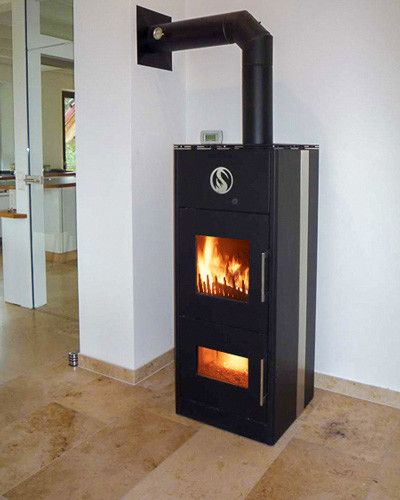
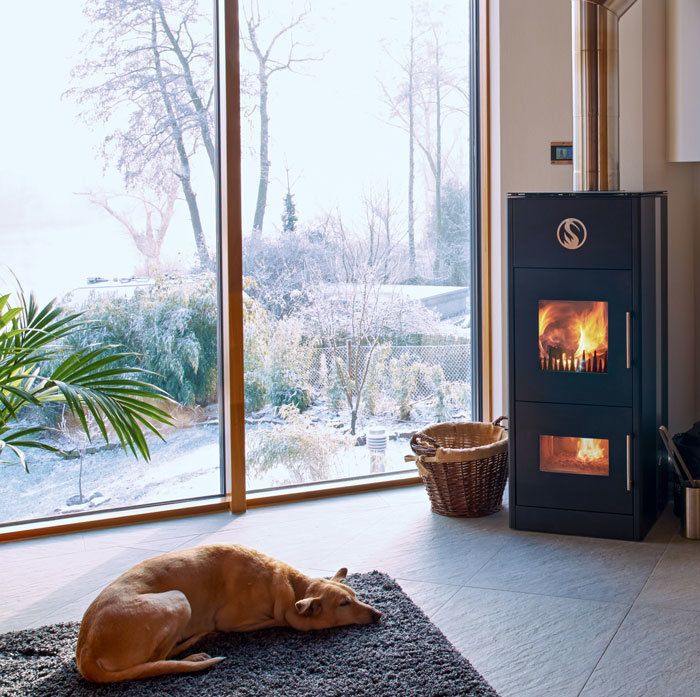
The LUVANO® boiler stove is built like a cellar boiler with viewing windows. This is why it transfers up to 85 per cent of its output to the heating water and just under 15 per cent to the room. In the 8kW version, that is around 1.2kW for the room where it is installed – within the range the report gives for new builds. By far the largest part goes into the buffer tank and from there into the underfloor heating and hot water preparation. At just under 15 per cent, overheating of the room is significantly reduced, and you can light the stove throughout the heating season. For a new build, the 8kW version is the obvious choice.
There is also a second consideration. Because heat demand in a new build is so low, wood can cover a large part of it there. What the LUVANO® makes possible is shown by feedback from our customers: some use 5 stacked cubic metres of wood a year for supplementary heating, others 15 and more. How much heat you get from wood is up to you.
This is how much energy is in wood
1 stacked cubic metre of mixed wood, half beech and half spruce, air-dried: around 1,600kWh. Sources: Bayerische Landesanstalt für Wald und Forstwirtschaft (Bavarian State Institute of Forestry), Merkblatt 12 (information sheet 12) (2024); Verbraucherzentrale (2026).
A new build is built airtight. Air burned by a stove no longer flows in through gaps, and a ventilation system often regulates the air exchange. This is why room-sealed operation is standard in new builds: the stove draws its combustion air directly from outside through a sealed duct, not from the living space. The LUVANO® is available in a room-sealed version in accordance with EN 16510 – previously already approved by the DIBt (German Institute for Building Technology); the combustion air connection is 120mm.
Contrary to a widespread belief, however, “room-sealed” does not mean that nobody needs to worry about the ventilation system and cooker hood any more. The information sheet of the chimney sweep trade treats the room-sealed stove with a cooker hood as a separate case with “special requirements”. The simplest solution is a hood in recirculation mode. If it works with extraction, a window contact switch only enables it when the window is open – or a measurement proves that no negative pressure greater than 8 pascals develops in the room. Another way of reading it makes it tangible: the room-sealed stove tolerates about twice as much negative pressure as a room-air-dependent one – no more. A powerful extraction cooker hood in an airtight house can exceed both.
Your local chimney sweep will tell you what applies in your house – their advice is what counts. We are happy to support you if needed. → Room-sealed
A new build is an investment for decades, often for the next generation. During the construction phase, solutions can be created that are later only possible with open screed or an opened wall – just as many builders today lay an empty conduit for the wallbox, even if the electric car is not yet at the door.
For the LUVANO®, there are four things. The lines for water, power and air supply are best laid in the floor straight away. They then enter the stove from below, so no lines are visible. The air supply connection has a diameter of 120mm. If the air supply duct is laid outside the floor, it must be insulated against condensation.
The chimney is planned in from the start. The flue gas connection is 150mm and is as a rule at the top; with the flue pipe, the LUVANO® is 1,370mm high. We therefore recommend providing the flue gas connection on the chimney at about 1.90m, measured to the centre of the connection from the finished floor. The buffer tank needs its place in the plant room: at least 500 litres, ideally 800 to 1,000 litres. And the stove belongs in the ventilation concept, which is drawn up anyway for a funded new build.
The heat pump remains the heating that reliably keeps the house warm every day. When wood is burning, the LUVANO® supplies the heat; if heat is lacking, the heat pump steps in automatically. The TOUCH control holds it back as long as the LUVANO® is burning or the buffer tank is charged, and the display shows you in kilograms how much wood the tank can still take.
With wood in the house, you also have a second energy source that you keep in stock. It makes you less dependent on electricity in terms of timing – a counterweight to the heat pump. There is a simple solution for a power cut too – talk to us. → With a heat pump
If you build with the KfW loan “Klimafreundlicher Neubau” (climate-friendly new build) to the Effizienzhaus 55 standard (KfW efficiency house standard), biomass is expressly permitted as a heat source – as things stand today, until 31 December 2026 at the latest and only as long as federal funds last. In an Effizienzhaus 40, wood stoves may be used if they are not required to cover the heating load and are not included in the energy balance of the house. Whether this applies to a boiler stove in an individual case is something you should clarify with your energy efficiency expert before applying. The LUVANO® itself is not eligible for funding.
→ Funding
In a new house, the whole building needs hardly more output than an ordinary wood stove gives off into a single room. The LUVANO® solves this through the ratio: only just under 15 per cent goes into the room where it is installed, up to 85 per cent via the buffer tank to the whole house; for a new build, the 8kW version is the right fit. It is available in a room-sealed version; the cooker hood remains a separate question. Air supply, chimney and tank are best planned at the shell stage – the heat pump steps in when heat is lacking.
Yes, if it draws its combustion air from outside and the ventilation system does not create dangerous negative pressure. Your local chimney sweep's advice is what counts. → Room-sealed
Only just under 15 per cent of the output goes to the room where it is installed – around 1.2kW with the 8kW appliance. Up to 85 per cent goes into the heating water. This is why it gets too warm there less often – even in the transitional season.
As a rule, the 8kW version. Which size suits your house depends on the heat demand in combination with the buffer tank and the room where the stove is installed. → Planning
Yes, and its own one: the wood stove may not share the chimney with another heat source. The flue gas connection is 150mm. Using our survey form, we assess suitability free of charge. → Request the form
Not across the board. In an Effizienzhaus 55, biomass is permitted; in an Effizienzhaus 40, conditions apply to wood stoves. Clarify this with your energy efficiency expert before applying. → Funding for new builds
In principle, the LUVANO® is a boiler stove in accordance with EN 16510 (previously EN 13240). Whether it has to be tested on a recurring basis nevertheless depends on certain circumstances. → Emission testing obligation