The drier the wood, the cleaner it burns and the higher its calorific value.
Firewood is sufficiently dry when its moisture content is below 25 per cent, based on the dry mass of the wood – as laid down by the 1. BImSchV (German Ordinance on Small and Medium Combustion Plants). This corresponds to a water content of 20 per cent. A standard wood moisture meter shows whether your wood has reached this value – provided you know which of the two quantities its reading refers to.
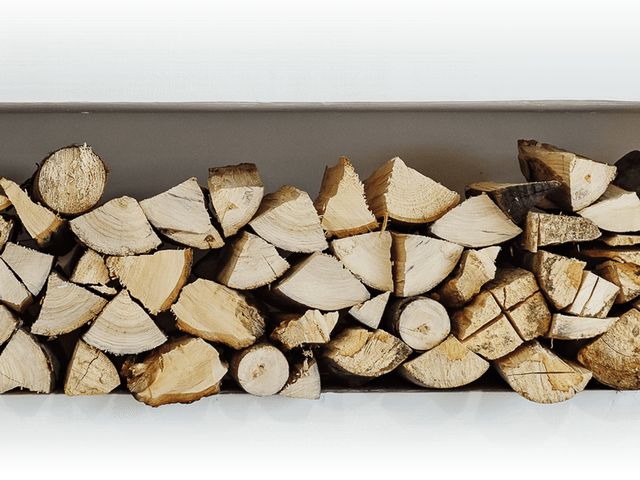
Anyone sitting by a fire hears it crackle. The cause is the water in the wood: it evaporates in the heat, the steam comes under pressure and bursts the cell walls. This is how the Handbuch Bioenergie-Kleinanlagen (handbook on small bioenergy plants) of the Fachagentur Nachwachsende Rohstoffe (German Agency for Renewable Resources) explains it. Even well-dried wood is never completely free of water. According to the Umweltbundesamt (German Environment Agency), freshly felled wood contains 45 to 60 per cent water, and after optimal drying still 15 to 20 per cent.
Damp wood has a lower calorific value. First, the water in the wood has to evaporate, and the energy needed for this is no longer available as heat. Above all, however, the combustion temperature drops: the wood burns less completely, more smoke is produced, and less heat reaches you.
The permissible residual moisture is laid down in the Ordinance on Small and Medium Combustion Plants, the 1. BImSchV. Logs and other solid biofuels “may only be used in combustion installations if their moisture content is below 25 per cent based on the dry or oven-dry weight of the fuel”.
What this actually says: the ordinance does not relate the amount of water to the whole log, but solely to the wood substance. What is meant is the weight the wood would have after complete drying in a drying oven. This value is referred to by the term “oven-dry weight” (Darrgewicht). A worked example: a log with an oven-dry weight of 1kg contains 250g of water and therefore weighs 1.25kg. Based on the dry mass, the 250g are exactly 25 per cent; based on the whole log, 20 per cent.
The Umweltbundesamt sums it up in one sentence: “A water content of 20 per cent, for example, corresponds to a moisture content of 25 per cent.” The 25 per cent in the ordinance and the 20 per cent that experts give as the maximum value are therefore not a contradiction. They describe the same state of dryness, just with a different reference value.
Wood moisture meters are available at DIY stores. For the measurement, split a log and measure in the middle of the freshly split surface, because the wood is often drier on the outside than on the inside. Also check in the operating instructions which quantity your device’s reading refers to.
Imagine your meter shows 22 per cent. Is the wood ready for the stove? That depends on the reference value. If the device shows the wood moisture based on the dry mass, the value is below the 25 per cent of the ordinance. If, on the other hand, it shows the water content, 22 per cent corresponds to a wood moisture of just over 28 per cent – this wood still needs to dry further.
How to read your meter’s display:
| Reading | Device shows the wood moisture (based on the dry mass) | Device shows the water content (based on the whole log) |
|---|---|---|
| 18% | below 25% – permitted | corresponds to around 22% wood moisture – permitted |
| 20% | below 25% – permitted | corresponds to 25% wood moisture – not yet below |
| 22% | below 25% – permitted | corresponds to just over 28% wood moisture – keep drying |
| 25% | not below 25% – keep drying | corresponds to just over 33% wood moisture – keep drying |
Limit value: 1. BImSchV § 3 para. 3. Conversion: wood moisture = water content ÷ (100 − water content) × 100.
When buying firewood, the Umweltbundesamt advises having the water content confirmed. If it is below 20 per cent, the wood moisture is also below the 25 per cent of the ordinance. The chimney sweep also pays attention to the fuel. Under the ordinance, anyone putting a wood stove into operation for the first time receives advice from the chimney sweep within one year, expressly also on the “proper storage of the fuel”. → Your chimney sweep
Split the wood as soon as possible after felling. Split logs have a larger open surface and release their moisture faster than unsplit rounds. In a trial in Freising, unsplit wood needed about two summer months longer to reach a water content below 20 per cent.
Stack the wood in a sunny, airy place – on pallets or square timbers and a hand’s width away from the wall. This lets the wind flow through the stack, and no moisture rises from the ground into the wood.
Cover only the top of the stack. The cover keeps rain and snow off, while sun and wind continue drying the open sides. It is also important in autumn, because from September onwards wood absorbs moisture again from the air and from precipitation.
You should not store freshly felled wood in the cellar or garage. There is no air movement there, and the wood hardly dries. A basket of dry wood for the next few days, on the other hand, can stand in the house. It is best to bring the wood in a day before burning it: its surface dries off further in the warm room air. If cold wood comes from the garage or from the winter weather straight to the stove, moisture condenses on its surface – even well-dried wood is then damp on the outside.
Depending on the type of wood, drying takes one to two years according to the Umweltbundesamt. Under favourable conditions it is quicker: according to trials in Bavaria, split and covered wood felled in winter can be ready for the stove by late summer, i.e. after nine months. This requires a dry, windy storage location at a distance from house walls and other stacks. Whether your wood is ready is shown by the meter, not the calendar.
The Umweltbundesamt recommends storing wood straight away in the form in which it will later be burned. For the LUVANO®, this means log lengths of 25 or 33cm. Its fuel chamber holds 25 litres, and one load burns for over three hours. With its wood gasification technology and the patented swirl chamber, it burns any type of wood.
→ How does a wood gasification stove work? · More about the LUVANO®
Natural, untreated wood including adhering bark is permitted. For combustion in the stove, low wood moisture is more decisive than the type of wood. The LUVANO® burns any type of wood.
Reliably only with a meter. Indications are drying cracks on the end faces and a bright, hollow sound when you knock two logs together.
That depends on what the figure refers to. Based on the dry mass, the wood moisture must be below 25 per cent, according to the 1. BImSchV. Based on the whole log, this corresponds to a water content below 20 per cent. Both values describe the same state of dryness.