Replace it completely at times – and take on a large part of the heating work over the heating season.
A conventional wood stove usually does not replace the heating, because it mainly heats the room in which it stands. A boiler stove also heats the whole house via the buffer tank and – depending on its design – can at times replace the heating completely. For the time without a fire, a second, automatically operating heat source makes sense.
A conventional wood stove gives off its heat mainly to the living room, often more than is needed there. Hardly any of it reaches the bathroom and bedroom upstairs. As heating for the whole house, it is therefore usually not sufficient.
A boiler stove transfers part of its heat to the heating water. Via the buffer tank, this heat reaches radiators, underfloor heating and hot water throughout the house, including the bathroom upstairs. Whether it thereby replaces the heating depends on when you ask: on an autumn evening, on a January night or in July.
And it depends on how the stove is built. Entry-level stoves without a water circuit heat only the room in which they are installed. Storage stoves release their heat for longer, but likewise only to this room. Boiler stoves are the first to also supply the whole house; many of them, however, still give off a considerable part of their output to the living room.
The LUVANO®, built like a boiler, takes the principle to its logical conclusion. Boiler does not mean: less wood stove. It means: a fully fledged wood stove with a visible fire – plus the advantages of a boiler in the cellar. The lower the output to the room in relation to the total output, the more often you can light the stove without the living room becoming too warm. Correspondingly longer is the part of the year in which the fire can relieve the heating or replace it at times. → From a simple wood stove to a boiler with a viewing window
Imagine a house with a boiler stove with a high water output in the living room and a buffer tank in the utility room. The existing heating remains as a second heat source, for example oil heating, gas heating or a heat pump. It works automatically as usual; nobody has to switch it on or off.
In autumn, the evenings become cool. You light the stove after work as often as you like. Whatever the house does not need directly during these hours charges the buffer tank. Heating surfaces such as radiators or underfloor heating, and the hot water, draw their heat from it – even long after the fire has gone out. As long as the stored amount of heat is sufficient, the second heat source is not needed. How long that is the case depends on the ratio between the heat demand of your house and the water output of the stove. In a suitable house, the stove thus replaces the heating completely at times. → Buffer tank
In January, the house needs heat around the clock, even when nobody is at home. But someone has to add wood. You light the stove in the evening, and at the weekend perhaps during the day too; during this time, the stove supplies the heat. At night the fire has gone out, and the buffer tank releases the heat it has absorbed. If the stored amount of heat is no longer sufficient, the second heat source switches on automatically – until you light the next fire. On very cold days, the heat demand of the house can exceed the water output of the stove; then, too, the second heat source covers the rest as required.
In February, you are away for two weeks. Nobody adds wood, and the stove stays cold. During this time, the second heat source heats the house on its own – without anyone having to check on things.
In July, you only need hot water, and there is no fire in the living room. The second heat source then takes over the hot water supply.
So over the year both have worked, each at its own time: the fire when you want it, the automatic system when it is needed. Does the wood stove replace the heating? On some days completely. Over the year as a whole, it works together with it. Our view: do not make yourself dependent on any one heating system. Fire and automatic heating complement each other – and you decide when each one works.
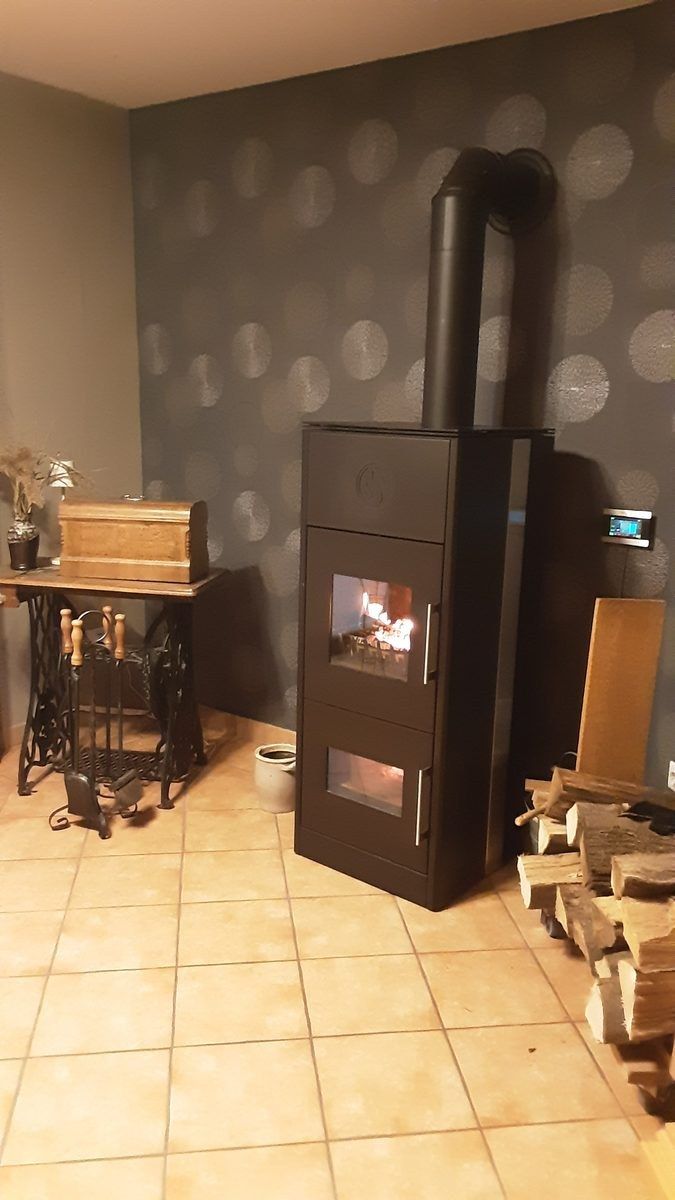
What share the stove takes on over the year depends on the ratio between the heat demand of your house and the water output of the stove. Added to this are the size of the buffer tank and how often you light the stove. There is therefore no figure that applies to every house. What the LUVANO® makes possible is shown by the feedback from our customers: some supplement their heating with 5 stacked cubic metres of wood a year, others with 15 and more. How much heat you obtain from wood is up to you.
This is how much energy is in wood
Almost as much as a newly built house with 150m² of living space needs in heating energy for the whole year (around 9,000kWh).
More than an older single-family house uses in heating energy per year (around 20,000kWh).
1 stacked cubic metre of mixed wood, half beech and half spruce, air-dried: around 1,600kWh. Sources: Bayerische Landesanstalt für Wald und Forstwirtschaft (Bavarian State Institute of Forestry), Merkblatt 12 (information sheet 12) (2024); Verbraucherzentrale (2026).
The principle is similar to a photovoltaic system on the roof. When it supplies electricity, the house uses it; when it supplies none, the house draws it from the grid without anyone having to switch over. How much electricity comes from the roof depends on the weather. With wood, you decide for yourself when “the sun shines”.
Every load of your own or regional wood is heat that you do not have to generate with oil, gas or electricity.
With the LUVANO®, the fire becomes the primary heat source if you light the stove regularly. As a boiler with a viewing window, it is at the top end of the scale: up to 85% of its output goes into the heating water, only just under 15% into the room where it is installed. Depending on the building, buffer tank, heat demand and heating habits, it can take on a considerable part of the heat supply over the entire heating season – in suitable houses, at times even all of it.
As long as your LUVANO® is burning or the buffer tank is charged, the TOUCH control holds back the second heating system – you set exactly how yourself. And if you deliberately want to heat only with wood, you block it at the touch of a button. That way you heat with wood when you want to, not because you have to.
An automatically operating heat source for the time without a fire makes sense. This can be your existing heating – or, if it is being replaced anyway, a heat pump or a pellet boiler. → Funding for the shared tank
One load burns in the LUVANO® for over three hours. How often you add wood is up to you; the rest of the time, the second heat source takes over automatically.
At times, yes: in a suitable house it replaces the heating as long as you keep the fire going and the buffer tank is charged. Over the year it works together with a second, automatically operating heat source – at night, on holiday and in summer. How much it takes on depends on the ratio between the heat demand of your house and the water output of the stove.